At the Gates of Mosfilm, 1993
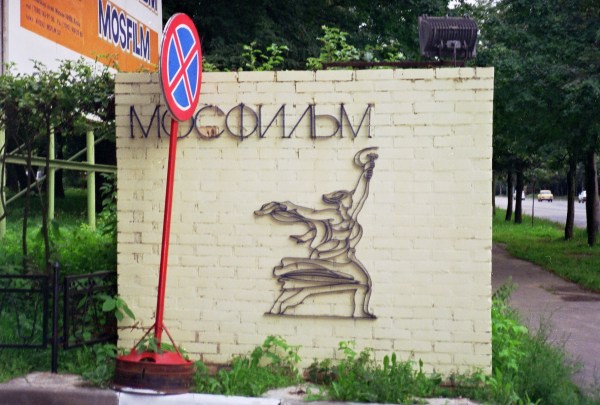
In the summer of 1993, when I was in my early 20s and already besotted with Russian culture, I had the good fortune to land a job at Mosfilm Studios in Moscow. The history of the studio had captured my imagination from afar, and each day that summer I felt that ghostly feeling one sometimes gets when inhabiting the present of a place whose past one has dreamed about. Whenever there was time, I liked to roam the studio grounds, or rather hover among them, convincing myself I could hear the talking stones. Here was a heavy building of beige brick, neoclassical, built to Stalin’s tastes, its authority softened by volunteer shrubs sprouting from the rooftop balustrade. Alongside it, a graveyard of rusted out baby-blue studio buses, each grill aged to uniqueness, destroyed in its own special way. There was a traffic light in an alley between soundstages; the lights had been removed; you could look right through it and see the sky. The studio had once been one of the world’s great centers of filmmaking. Now on certain days I could walk from one end of the vast grounds to the other without bumping into anything resembling a shoot. For me, a kid from Las Vegas, there was a strangely familiar air to the place—it felt like the hollowed downtown of an American city after the construction of a suburban mall. And the feeling was apt: Russian film fans had gotten their mall—the miles of roadside kiosks hawking cheap pirated copies of Hollywood films, many of them straight-to-video jobs of which I had never seen or heard. Without its once lavish state support, the studio had no way to compete with such masterworks.
My job was to translate, coach dialogue, and occasionally dig holes on the set of what was at the time Mosfilm’s marquee project—a Russian-Italian-American joint venture. 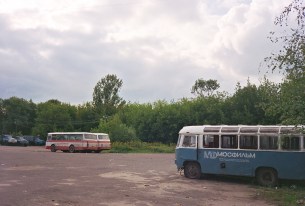 We were making a Western. Starring an Italian. Filmed chiefly on a military base an hour outside Moscow. Each morning we all came to the studio, boarded one of the less distressed of the picturesque blue buses, and headed for the set. On my first day of work I had taken the Metro to Kiev Station, caught Trolley 34 to the gates of Mosfilm, and showed my documents to the guard. I’d arrived early. I didn’t know who to look for, where to find them, or quite how to explain my presence. I knew the history of the studio, but its present, and my present, were something of a mystery. The guard waved me through. I wandered onto the grounds. And there I did what one does on a film shoot. I waited.
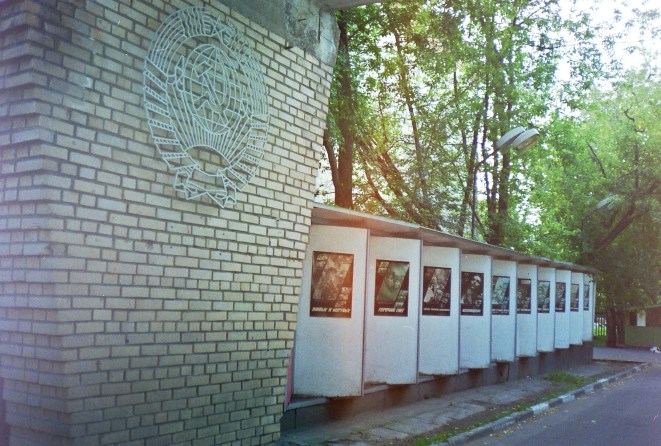
I could have kept waiting all day. There, just inside the gate, was a long row of displays encased in scratched and fogged Lucite—posters of the majestic movies of Mosfilm’s past. 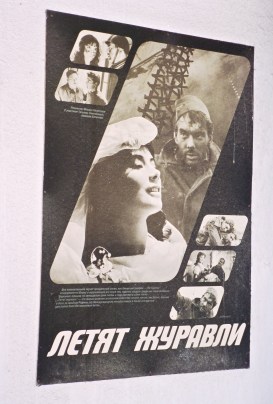 Here was Grigorii Chukhrai’s 1959 classic Ballad of a Soldier. Over there—Mikhail Kalatozov’s 1957 masterpiece The Cranes Are Flying. Eight-thousand miles and eleven time zones from home, I found myself longing for a lost time and place, but it was not a time or place in which I or any of my ancestors had ever lived. In the third year of the bewildering Muscovite 90s, in the heart of the world’s first attempt at a post-Socialist society, I found myself missing a Russia where the chocolate came not from M & M Mars but from the Red October Chocolate Factory, where the soundtrack of the times emitted from the voice box of Vladimir Vysotsky rather than the synthesizers of a Scandinavian globo-pop outfit called Ace of Base, and where the Shock Worker movie theatre on the embankment of the Moscow River was showing The Cranes Are Flying. This fantastic daydream made no sense: I had studied the Soviet century, its deprivations, its brutalities both grandiose and audaciously petty. I could not possibly “miss” the Soviet Union. And yet, on that day, in that peculiar way, what could I say but that I missed the place? Continue: Read the full introduction to “Reentry Shock.” (The essay picks up from here on page four.)

That’s me, back then. Had fun. Time flew.
From the Archives: Russia, Ukraine and the Battle of Yesterday
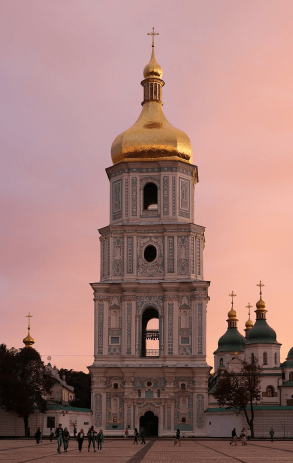
(A 2026 update to this 2020 update: Six years ago I wrote this introduction to a piece I wrote six years before that. What strikes me is my line about the lingering sense that the histories of these two nations were inextricable. Looking back, I wish I had added that sometimes–as Thomas Jefferson wrote 250 years ago–a people must extricate themselves from just such bonds. Ukraine’s fight was and remains a heroic effort “to assume among the powers of the earth the separate and equal station to which the Laws of Nature and Nature’s God entitle them.”)
•••
Six years ago, those of us who had studied Russian and East European history and culture already understood that the emerging conflict between Russia and Ukraine would shake the world, but we could not have predicted the strange ways in which its tremors have rattled internal politics across Europe, North America and beyond. In early 2014, Ukraine, placed once again on the balance beam between East and West, deposed its leader and attempted a westward tilt. Russia responded swiftly, exploiting Ukraine’s cultural rifts and historical peculiarities to annex Crimea and stoke a civil war in eastern Ukraine. Western sanctions followed, which were in turn followed by an accelerated Russian information (and disinformation) campaign to undermine faith in the kind of Western political structures Ukraine had wanted to join and emulate: Liberal democracy would seem far less enticing if it could be demonstrated that it worked poorly and led to chaos.
Today, with the United Kingdom withdrawing from the European Union, illiberalism on the rise in Central Europe, and transnational bodies of liberal governance ridiculed across the West as feckless and out of touch, it’s hard to envision a world in which, just a few years ago, Ukrainians risked everything to take a step toward an EU that seemed the guarantor of stability. It also remains difficult, after six years of political and geopolitical repercussions, for Westerners to understand what Ukraine’s choice that fateful winter meant to Russians (and many Ukrainians) who considered the histories of the two countries inextricably bound. In March 2014, I wrote a short essay introducing those complicated histories to the readers of Vegas Seven. (Even in the age of the global Web, it’s important to have thoughtful local discourse on international matters.) After years of political posturing in which interested parties try to simplify and spin the conflict to their advantage, it seems worthwhile to post this little primer once more: “Russia, Ukraine and the Battle of Yesterday.”
Greg Blake Miller is a former staff writer for The Moscow Times. He holds a doctorate in international communication from the University of Oregon and earned his master’s in Russian, East European and Central Asian Studies from the University of Washington’s Jackson School of International Studies.
Wilshire and Citrus
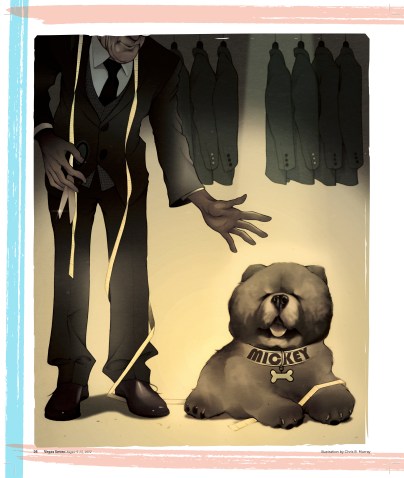
Illustration by Chris B. Murray for Vegas Seven.
A man, his dog, and a Great Depression
By Greg Blake Miller
(This story originally appeared in Vegas Seven, August 9, 2012.)
On a scorching Sunday in late June 2012, my 11-year-old son and I finished a baseball workout, stopped at Thrifty Ice Cream on Las Vegas’ Pecos Road, bought a chocolate milkshake and took it to my 100-year-old grandmother, Lillian Lorand Dubin. She peppered us with questions about our changing little world—a new baseball team, a new home, a new dog. Most of all, she wanted to know about the dog. Then she repaid us with a dog story of her own.
My great-grandfather Erno, she told us, had a dog, a honey-colored chow named Mickey. Mickey belonged to Erno the way only certain dogs belong to certain people—for better, for worse, and forever.
Erno had come to the United States from Budapest around 1910 and settled in Cleveland’s burgeoning Hungarian community. He had been a handsome young stage actor and singer; his parents owned a prosperous lumber business in Szeged and considered acting an unworthy profession. He didn’t want to shame them, but he wanted to keep acting, so he changed his name from Laszter to Lorand. I have in my photo album a shot of Erno posing rakishly among his fellow performers; it’s a sharp crew, Budapest’s most eligible bachelors. They’re standing on a busy city street, in the back of what appears to be a wagon, ready for an audience. Among Erno’s friends was S.Z. Sakall, who would later grow portly, earn the name “Cuddles” and play Carl the waiter at Rick’s Café in Casablanca.
In Cleveland, Erno set to work making suits and courting a young woman, Lenke Marton, the second of 17 children from the Hungarian village of Szamosújvár. He married Lenke. He dreamed of making his way to Hollywood and onto the big screen. A girl was born, and then a boy.
In 1929, he and Lenke set off for Los Angeles in a brand-new Essex with their 17-year-old daughter, Lillian, 14-year-old son, Joe, and Mickey, the honey-colored chow. The car broke down in Lawrence, Kansas; there was no money for repairs, so they left Joe’s violin for collateral. They arrived in L.A. and ransomed the fiddle. Movies spoke by that time, and they did not speak with a Hungarian accent. Erno remained a tailor. With his brother-in-law, he started a clothing business. Dreams were still possible—just different ones. Within months, the stock market crashed.
Erno was a proud man, who loved his family fiercely and raised his daughter strictly. He was a cosmopolitan Jew, non-dogmatic but filled with faith in the sanctity of doing things right; he embraced America for everything America believed itself to be. He believed in culture and the beauty of language and the importance of practicing the piano. The Depression did not suit him.
What suited him was Mickey the honey-colored chow, who did not care whether he was a tailor or an actor or a man deeply wounded by the fallen economy. Mickey was by Erno’s side through work’s endless hours—fabrics were chosen, clients were measured, patterns were cut, books were kept.
When the work dried up, Mickey did not leave Erno’s side. When the stomach infection set in, Mickey did not leave the bedside.
Erno died in 1932 at the age of 43.
The day of the funeral, Lenke, Lillian and Joe sat down in the car and began that longest of rides, and Mickey took off running behind the wheels. He chased the car down the street, around the corner, through the crowded avenues of Boyle Heights. He ran and ran, and finally they stopped and Mickey climbed in and went to his master’s funeral. After that, he followed Lenke wherever she went. In their bond, Erno survived—his authority, his embrace, his fierce and unyielding dreaminess.
The Lorands moved from Boyle Heights to an apartment on Wilshire Boulevard and Citrus Avenue. Lillian supported the family on the $25 a week she made as a secretary at Occidental Life Insurance. She was a champion typist; she took dictation from A.P. Giannini, the founder of Bank of America. Mickey, meanwhile, was Lenke’s constant companion; he knew Wilshire well, and Wilshire knew him, a dog about town. One day a year after Erno’s death, Lenke and her sister-in-law went shopping on Wilshire. As always, they brought Mickey; as always, they tied his leash to a post outside the store.
When they came back outside, he was gone. They walked for blocks, looking down every street and alley. They went home. Mickey did not follow them.
A year later, Lenke and her sister-in-law emerged from the same store and heard wild but muffled barking. They spotted the source, behind the passenger-side window of a Packard. The dog leapt and howled and whimpered. It pressed its nose against the window. It scratched at the glass with its paws. Lenke waited for the car’s owner to return. He arrived, he opened the door, the dog jumped out and ran to Lenke.
“This is our dog,” she told the man.
“No, it’s not,” the man said. “He’s mine. I bought him right here a year ago.”
The dog jumped up on Lenke; it practically embraced her with his paws. Lenke looked the man in the eye.
“Look at him,” she said. “Don’t you think he’s my dog?”
The man hesitated, looked, drew his breath in and let it out slowly.
Mickey went home with Lenke.
There are things dogs know and things they don’t know. Some people say it’s all just instinct. Maybe so, but Mickey had an instinct for family— and he knew this one was his.
Years later, when Lenke became too ill to take care of Mickey, she gave him to a home for elderly Jews, where he kept everyone company. He was kind to them all—and they loved him back. But sometimes Lenke would come visit, and all the old folks—no strangers to the way a feeling could endure through pretty much anything—could see that no matter where Mickey lived, he knew exactly where home really was.
From the Archives: In Praise of Sneaky Irrelevance

In the third month of the year 2011, in a fit of vintage 21st-century madness, the University of Nevada, Las Vegas—my city’s school, a school I loved in a city I loved—proposed eliminating its department of philosophy, among others. While that particular madness ultimately faded at dear old UNLV, I suspect it lingers in the broader culture, where we often forget that quality results come from quality process, quality process comes from quality thought, and quality thought comes from supple and creative minds. So it makes sense to train those minds to think beyond the technical specifications of the latest and soon-to-be-obsolete job posting. Anyway, that’s what I argued in 2011. It was old-fashioned then, and it’s older-fashioned now. But I trust that America still loves a good antique. Here’s the case I made in the pages of Vegas Seven, “In Praise of Sneaky Irrelevance.”
Photo illustration by Thomas Speak for Vegas Seven.
From the Archives: Throwing Rice
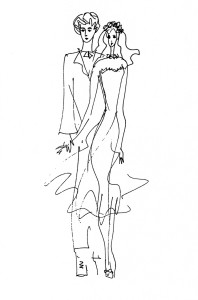 [In the late 1990s, just back from working at the Moscow Times, I lived in Los Angeles, writing, finishing my MFA, and working as everything from an editor of drivers-ed textbooks to a Santa Monica Mountains dog walker. I was getting used to a new way of being in the world—and of being back in my own country—and I loved to wander the many worlds encompassed in those two strange and lovely letters, “L.A.” This peculiar little matrimonial Halloween tale appeared in the 1999 edition of the Southern California Anthology.]
Illustration by Svetlana Larionova Miller.
Throwing Rice
West Hollywood, California, October 31, 199-…
The violinist played a sonata whose title we had already forgotten.
We listened, we spoke.
Avowed bachelors and bachelorettes received the tokens of their doom.
Family members and the friends of their friends asked us questions about money.
We danced to a song nobody else knew.
And they left.
And, walking through celebration’s ghostly afterglow, so did we.
Only the china remained, scraped-off cake frosting drying in gargoyle formations.
★
The city. On our own.
Cars lined up and sniffing at each other like unfixed dachshunds. Yapping and growling and making impact, but nobody’s getting any satisfaction tonight. Just be patient. Everyone wants to celebrate. Just be patient.
“It’s a vintage hotel.”
“Vintage?”
“Nineteen-twenty-something.”
“Oh, how nice.”
“That means no underground parking.”
“I’ll keep an eye out for a space.”
★
We got within two blocks. Nothing. We turned back. Twenty-three blocks from the Hotel Concordia we parallel parked, our Subaru’s tailpipe pointing the way to our honeymoon suite.
★
“Here comes the bride!”
They spoke simultaneously, two white-bearded young fellows in green three-piece suits, top-hats, and brass-buckle shoes.
“Are you gonna bring us luck?”
“You look great, honey! We almost wore that today!”
“Why, thank you,” she said.
★
With the rest, we flowed like plasma onto a main road.
Here car traffic was blocked off by striped sawhorses, orange cones, a vast array of silver and yellow reflectors, and a single burning flair.
“First night, baby!”
It was a mustachioed man in blue baby pajamas with booties and a hood.
“Yep.”
He took a long suck on his passifier.
“Mind if I join you?”
“Maybe the second night.”
“Aw, that’s no fun.”
★
A cheerleader hopped about not far in front of us, skirt flying up over smooth and muscular legs, short shirt lifting to reveal the tanned and toned contours of a lower back.
The cheerleader turned around, spit out some cigar juice, wiped the ashes off his goatee and smiled at my wife.
“Hey, hun, that’s what I wore last year!”
“Where did you rent it?”
“Rent, hell! I get a lot of wear out of that little number!”
“I’d love to compare sometime.”
“Honey, I’ll be around. If you search, you shall find.”
He smiled and skipped away.
★
My wife smiled at me.
I remembered a certain day walking by the track, turning to see the trumpeters boogie in the distance while the Professor of Marchingbandology, apparently a member of the revolutionary Frente Marchingbandista, barked commands over a loudspeaker. The trumpeters kept playing the chorus of “Carry On Wayward Son” again and again, each time interrupted by the sandpaper yelp of the Professor, who appeared to be an exiled New York intellectual named Bernie. A comical and graceless scene.
Then in floats my ironic counterpoint, the love of my life, all tights and tanktop and tanned arms, twirling a baton, twirling herself, twirling my heart…
When she lifted her arms and the shirt rose with them I felt the curve of her side upon my cheek. I rose and rose toward the hourglass pinch, a fine golden cilia haze tickling my new-shaven skin.
I felt like a pervert and a stalker and a happy young man and I waited and we dated and now she is my wife.
★
Actually, that’s not how it happened at all, but that’s the memory of her my imagination drummed up after seeing the goateed, cigar-smoking cheerleader.
Not a bad memory, for a fake one.
★
But there is something real here, something real and beautiful, I told myself, remembering an overcoated February afternoon near lake Michigan when two faces wrapped in scarves somehow saw enough through the wool to agree to coffee. The image may not throb and burst for you. But for me…
When the feather of a frame of life brushes me just so….
I feel it in my teeth. That’s where I feel it. A tickle in the teeth.
And the tickle is only reflectively felt. I don’t feel it when I read the sentence, but when, having read it, remembered it, reread it and remembered it from another angle, after investing faith and patience in it, I don’t so much remember it as burn it into my genetic code. I feel the tickle when something dear finally becomes a part of me. The feather’s touch is delayed, like the echo from a deep canyon. But it is sweet.
And I felt it there, walking with my wife. She was golden in a white gown, the most beautiful vision in the…
But the featherframe tickling me was she in a heavy hood, her burgundy scarf hiding lips I had yet to see.
★
I like the nightlife/ I like to boogie/ On the disocoayaiii!!!
I think it was Donna Summer who walked by us with a ghettoblaster, but I can’t be sure. Perhaps it was Dionne Warwick.
Anyway, she stopped and said Mazeltov.
We looked almost like the real thing, she added.
★
The crowd grew too dense for conversation. There was a red devil with a calico cat on its shoulder. There were any number of Elvises, one of them in a pink leotard. There was a blue Martian (“No, dammit, I’m Venutian”) with a giant papier mache erection that he kept pulling off and happily waving around. At the end of it was a white flag with the words “I surrender” written in laundry marker.
I tried to keep my eyes on the hotel in the distance, but three Sitting Bulls in pastel headdresses found their way in front of me. From then on I was the Miata behind the Mayflower truck, trusting those mightier than me to indicate the redlights and the greens and the exits off the freeway. I’m not that tall anyway, so it was just a matter of time, headresses or no….
★
A lad with a shaved head tripped over his jackboots and fell hard into my side. Instinctively I put out my hand to help him up. He sneered at me and I almost threw him back down. Then he smiled quickly and said with a gingerly lisp, “I’m not a Nazi but I play one on TV.”
“And you play it well.”
“Speaking of playing well, you two don’t look bad yourselves!”
“Well, we study the parts.”
“Oh, that Strasberg stuff just drives me crazy. I can never fully relax.”
“Yeah, that’s always tough.”
“As a matter of fact… Yes, I see it, just barely, but I see it. You’re not fully relaxed. You’re still playing the role. You have to be it.”
“We’ll work on it.”
“Oh, she’s doing fine. It’s you that’s got the tension thing going…. Wups, there’s my gang!”
He gestured to a pair of pretend skinheads to his right.
“I hope everybody gets your irony.”
“Oh, who cares.”
“Well, you’re pretty brave coming out here like that.”
“Oh, no, honey. You’re brave.”
And my new friend was gone.
★
“My feet are killing me!” she said.
“You’re tellin’ me!” called out a guy in stilettos and fishnet.
“We’ll get there soon.”
“How do you know?”
“It was straight ahead. If we just keep going, we’ll get there.”
“I’m just gonna collapse to sleep.”
“We’ll get there.”
★
If you take a rain check on your first night, is the second night your first night? Or is there only one first night, a single pitch down the middle, to be hit or missed but never to be seen again. Is there ever another such pitch? If you miss the first night, or foul it off, do you just swing wildly for the rest of your life, hoping for that grapefruit you can nail, hoping and hoping as Cupid the peashooter keeps flingin’ ’em up there for you to foul into the dugout or pound into the dirt. Do you swing wildly? Or do you play it disciplined, have a good eye, plan the romance, meticulously re-create that which was missed… Create just the right throb and doublethrob and unforgettable explosion…
The crowd goes wild.
★
I forgot for a moment about the feather I’d already felt.
“Stay awake. We’ll get there.”
“So I can sleep?”
I stared at her.
She wasn’t smiling.
“We’ll get there.”
★
If you just take the pitch on the first night, are you really married? What makes you married? Bowties and lace and little plastic people planted in lemon spongecake? Your lasting love, which pre-existed and will post-exist the masquerade? Or is it the overall transformative portrait of that day, the throb, the reality so sharp that it burns in right at that moment, not later in review, but right at that moment, a legend simultaneously lived and recited, a painting whose greatness is assured even as the artist lashes at a half-empty canvas…
★
Someone belched in my ear.
Someone elbowed my wife.
Someone stepped on the heel of my shoe.
★
I wanted my legend. I didn’t want subtlety, irony, comedy. I wanted my legend. I wanted my throb.
My wife was falling asleep on my arm.
★
“Hey, look honey! It’s another pair of newlyweds!”
The voice rang out from several feet away. We felt the plasma around us rearrange itself as a pair of plastic people flowed toward us. It was a nice looking fellow and a lovely blonde bride who could have been us if they weren’t just playing at it…
“Wow,” said the fellow, now alongside me. “You guys even have that exhausted look! Don’t they look like the real thing, honey?”
“Oh, dear,” she said, addressing my wife, “pardon my husband we’ve just had a real wedding today. We didn’t expect to get caught in this! You two do look good, though.”
“Thank you,” my wife said sleepily.
“We’ve got a honeymoon suite at the hotel up ahead,” the man said. “I hope we get there before the little lady here conks out on me.”
“Don’t bet on it,” said the little lady.
“Aw, hell, they’re always down just when you get up,” said the man, his voice all bubbly and weightless.
“Actually,” I said, “We really do have to get to the hotel. We really did get married today. And our wedding night really is getting fucked up.”
“Hey there, don’t get sore,” said the man. “We didn’t steal your costume idea. We just picked a weird day to get married, I guess. Suppose we should’ve left tonight to the pretenders.”
“We’re not pretenders.”
“Sure you’re not.”
“You’re pretenders.”
“No, we’re the real thing.”
★
My wife’s head was on my shoulder, her eyes three-quarters shut. She breathed rhythmically, like a curled cat before the fireplace.
“These people take their dress-up games seriously!” the man was telling the woman.
We walked on, the four of us, to the hotel, where something would happen, or nothing at all.
From “The Bass Violin” in the collection “Decemberlands”
The Seventh Day
It was one of those winter mornings when you look outside and can’t bear the thought of being inside another minute—the sky blue as a storybook sea, the sun slanting in, hitting the window hard, throwing a golden square on the bedroom floor, and, in the center of the square, the sharp-edged shadow of you. These are the mornings when you throw open the window—never mind the frost, the unmistakeable sensation of your nose turning pink with chill, the sound of your mother telling you you’ll catch your death of cold standing there in your cotton pajamas, never mind all that—you breathe in deep and the air tastes like mint and the day ahead feels limitless. Yes, you’re already old enough to know that every day has its limits. You know that days like this in particular can’t help but disappoint. You’re no fool, after all, the most levelheaded of all the levelheaded kids in the Bronx. But you let yourself expect, if only for a moment, that something wonderful will happen today…
Read more in my illustrated holiday short-story collection Decemberlands, available at Amazon.com.
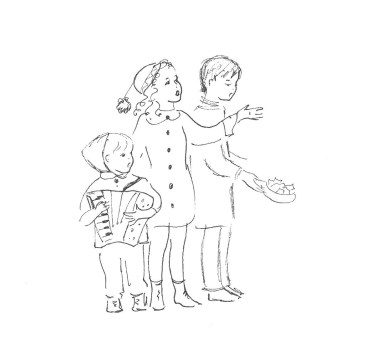
Illustration by Svetlana Larionova Miller, from Decemberlands.
From the Archives: Gorby and Me

How the leader of a foreign superpower changed my life—and a few others, too
[Originally published in the Las Vegas Weekly, March 25, 2004]
When I was a little kid—and I must have been an odd little kid, now that I think about it—I always dreamed that I would grow up to be the guy who ended the Cold War. Then along came Mikhail Gorbachev and ruined everything for me. I was 15 when he came to power and 22 when he left it and even his theft of my prospective life’s work couldn’t peel me away from my desire to study the country he’d led and lost. A master’s degree and three periods of scantily remunerated, definitively non-world-transforming work in Russia later, I was 27 and sick with the certainty that I’d become irrelevant. I beat a path back to my hometown, Las Vegas, to try to find a new mission in the real world. I’m still looking.
That’s one story. There are others.
Gorbachev, the former and final leader of the Soviet Union, came to UNLV last Monday, March 22, to talk about how to make the world a better place. I listened attentively. I took notes. I was truly interested. But my interest in the man’s words was in constant competition with my awe at his presence. Every time he spoke about our future, I kept thinking about his past. Every time he spoke about our world, I thought about the extent to which he made it what it is. This is the pathos of displaced greatness: The central historical figure of our time was standing in the Thomas & Mack Center telling me and several thousand others his prescription for restructuring global priorities, and my mind was not on the implementation of his new ideas, but the impact of his old ones.
OK. Full disclosure. My mind, as minds will be, was also on my own life. I felt a little ashamed of myself. What kind of person goes to listen to a Nobel Prize-winner speak and sits there thinking, Boy, that guy really did a number on me! But he did a number on millions, not such a bad number, all things considered. If we all sit and think about the numbers he did on us, the numbers start to add up to something like a revolution.
★ ★ ★
By the time I was in third grade, I had effectively grokked the meaning of deterrence. When the subject of the Cold War came up—and, believe it or not, at Lewis E. Rowe Elementary School, it did—I liked to say things like “strength makes peace.” At the same time, I’d tell people that the original reasons for the arms race were pretty much lost beneath all the shiny missiles. I was against the unilateral-freeze movement, but I figured that if the two sides could be brought to discuss not their weapons but their actual differences, they might realize together that neither of them really needed the capacity to blow the world up a 10th time. Leonid Brezhnev was not listening, and I don’t think they heard me on this side of the pond, either. I decided to bide my time.
Several years later, Mikhail Gorbachev announced to the world, and perhaps more courageously, to his own generals, that effective deterrence didn’t really require that many bombs, and advocated a defense stance not of supremacy but of “reasonable sufficiency.” Gorbachev’s idea worked. I bore him no grudges. I was a good kid that way.
★ ★ ★
An actor named Boris, wearing a cowboy hat and a dusty vest, was to burst into a saloon, doors swinging behind him, and shout out, “Which one of you bitches is my mother?”
No. That was Phoebe Cates in Lace. The mind plays tricks that way. In any case, Boris, a good guy playing a bad guy, was to barge in and make some sort of menacing cowboy declaration, and I was to coach him to say it well enough, cowboy-like enough, that at least the dubbing wouldn’t look ridiculous. We were on a closed Russian military base outside the provincial town of Golitsyno and about an hour from Moscow by slow bus. It was July of 1993, during my first trip to Russia, and we were shooting an Italian-American-Russian joint-venture western called Jonathan of the Bears, starring Franco Nero and a nice South African girl named Melody. Franco had been raised by bears; Melody was a Native American named Chaya. Then there was Boris. Boris, with a long, bent nose, bulgy eyes and a snaky frame, was taking care of some sort of Old West dirty work or other. I think he may have been some kind of cowboy scientist.
My job was to help everyone with a little bit of everything—dialogue coach, occasional translator, mover of things from one place to another and back. Sometimes my job was to do nothing at all. One day I was sitting with a group of Russian actors and stunt-men in a circle around a puddle. We were throwing pebbles in the puddle. We were watching the circles spread. “I want to work,” I said.
“This is work,” Boris answered.
I liked Boris. Read more…
From the Archives: Revolution Square
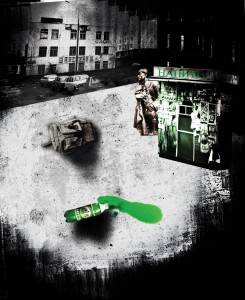
It’s 1996, I’m writing for The Moscow Times and wandering the parks and alleys of the capital, gathering it in, allowing it to become a part of me, each day finding new mysteries in its cool air and cold lovely stone. It’s my third tour working in this country; I’m no longer entirely a stranger here. But Russia, weird and wondrous, can’t help but leave even the most experienced foreigner feeling just a little bit strange. Here’s one of my adventures—and maybe not my proudest moment—described in a 2012 essay for Vegas Seven, “Revolution Square”.
From the Archives: The Morality of Slow

In 2011, I was editing the weekly city magazine Vegas Seven and recalibrating my sense of place in the hometown to which I had only recently returned. The city was at once deeply damaged by the Great Recession and, as always, energized and ready for change—constantly reshaping itself beneath our feet while we hurried from one moment to the next trying to keep up with it. Meanwhile, our digital existence seemed to echo our civic life, skittering about in our mental space, ever-shape-shifting, keeping us continuously looking down to make sure we understood where we were, seducing us into forgetting where we had been, telling us not to slow down, not ever, lest we fall behind. Amid this instability of both physical and virtual space, I reached a point where I sat down at (where else?) the keyboard and typed a thousand words that, I suppose, amounted to one: “Enough.”
Here’s the result—“The Morality of Slow.”
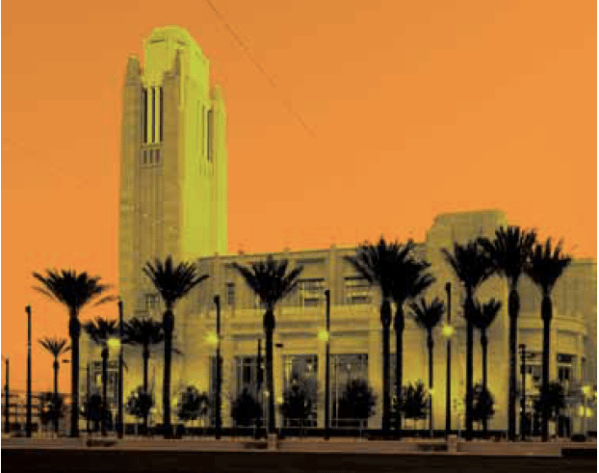
Seven years ago, with Las Vegas still digging out of The Great Recession, a national commentator argued that The Smith Center was the tomb, rather than the launching pad, for the city’s civic energies. I disagreed, a lot. This was my reply in the late, great Vegas Seven. How does it hold up?
Miller-March 29, 2012-Is The Smith Center the Last Good Thing?

