The Listener

Robert Redford was my favorite actor across the decades for many reasons: on the screen he could be charming, funny, controlled, hassled, stoic, outraged, eager, and profoundly patient—all convincingly, and sometimes in the space of a single role. As a director he was fearless and visionary and sensitive to the wounds and glories of life, small and large. One of the joys of encountering Redford onscreen was watching him listen—for Redford listening was an action; he entered into the world of the speaker, engaged with their thoughts, and visibly formed his own, which often went unspoken. But for me the greatest of his performances—and one of my all-time favorite films—was “All Is Lost” (2013), where all he had to listen to was the sea, the creaking of his damaged boat, and his own silent thoughts. The film, almost wordless, was a masterclass not only in the precision of physical action, but also in the actor’s profound art of expressing a rich internal world without making a sound. He played the role at age 75: all of the old charms remained, and with them a weathered but hopeful stoicism that should speak to all of us.
– GBM
The Doctrine

The Doctrine
Or, The Provocateur Shuffle
Raid!
Inspection!
Resistance, insurrection!
Three days running
And your ratings were low
So you called in your yes men:
Time to put on a a show
There’s vermin in the chapel
The blood’s impure
The country’s getting sicker
And you know that you’re the cure
You tell them what to do
And they can only say, “Yessir!”
‘Cuz their minds are getting weaker
And they’re hooked on the allure
Of your malice and your palace
And your gold-plated throne
And they whimper and they howl
For you to throw them a bone
And you’re teaching them
The virtues of a heart of stone
Of the beauty of pain
Of a boot on a neck
Of the hiss of the dying
Of the final groan.
Let’s roll now:
Raid!
Inspection!
Resistance, insurrection!
Pull the father from the mother
And the mother from the son
And you’re watching it in 4K
And you’ve never had such fun.
They’re asking for their papers
And they’ve got ‘em on the run
Now your ratings are improving
But you’re still not done:
Grab the workers from the warehouse,
And the schoolgirls from the nuns
And if they break away
Time to bust out the guns.
Let’s roll now:
Raid! Inspection!
Resistance, insurrection!
Civil disobedience in the intersection!
There can be no letter from a Birmingham jail
Back then they succeeded
But now they’re bound to fail
A match is lit,
The stink of burning tire
And it’s perfect, ‘cuz you’re waiting for your
Reichstag fire.
You’re shrinking from the world, but it ain’t no sin
When the real enemy is the one within.
Let’s roll now:
Raid!
Inspection!
Resistance! Insurrection!
Lock ‘em up now, yeah, it’s better than sex
Send in the tanks like Brezhnev did the Czechs
Your gain, their pain
Your car, their lane
Your parade, your glory, their prisoner train.
They’re mad, you’re sane,
Their blood, your stain
You’re dreamin’ California as your Ukraine.
You speak invasion,
Evasion,
Obfuscation,
No persuasion.
You’re hired, they’re fired
In the nation you sired
You’re high on you,
And we’re dog tired.
Let’s roll now:
Raid!
Inspection!
Resistance, insurrection!
But Tyrant Lane, it twists, it turns
The ember’s lit, the world, it burns
You love this war, your rules, your game
It always ends badly, but you say you’re not the same
Mounds of scoundrels in history’s bin
Nero to Stalin, but you’ll save ‘em with spin
When up is down and dark is light
You can rule the world
With nothing but spite.
Let’s roll now.
— GBM
America After

America After
The sun was bright, our moods were light,
The beers, the cheers when he said “Fight!”
We built the pyre and lit the fire
And closed our eyes to count to three
And when we woke it was no joke:
New rules, old fools, scorched earth, fresh smoke.
Reborn lads and relieved dads
Lit up joints and prayed to Thee:
“O man of gold, what have you sold?
What thrones, what bones, what souls grown cold?
You sing, you sting, you clear the ring
You raise your fist for all to see.
You rule the stage and loose our rage,
You’re here to save, you make us brave.
Hot lead, cold dread: they move, they’re dead:
Their silenced pride, their saddened glee!” …
Eight years now gone but life goes on:
It takes, it breaks, I rise at dawn,
Still give a fuck and load the truck,
Memorial Day! Hail Jackson and Lee!
A feast grown stale, a flag bleached pale
Dry dips, wet chips, slashed tire, closed trail
Picnic ants and podcast rants,
A gun, a deer, an axe, a tree
A Pyrrhic win, a dusty bin
A spike, a pike, a wish, a sin
A pipe of lead, a damaged head
A cage we built while breaking free.
What remains beyond these strains,
The days ablaze, the phantom pains?
What can last when all is past
And our road has hit the sea?
Windswept sands, these bitter lands
The whales on scales, our bloody hands,
The cuts are made, the earth’s afraid,
And all have left but you and me.
Who am I to lead the dead, Moses on the mountain said,
Once enslaved and ill behaved, a people freed but full of dread.
The stars are torn, the stripes are rent,
The rope is frayed, the pole is bent,
My heart is willing, but my strength is spent
I said we’d make it, but is it really what I meant?
We stayed but, love, we should have fled,
The bacchanal is at an end,
We’ve brought the needle and the thread
But not the skill required to mend.
– GBM, May 26, 2025
The President Negotiates a Peace Deal
I’ll end this war in just one day
I’ll win the Nobel Prize
And watch the bleeding millions pray
To gods who they despise
Beneath the bombs on peace’s eve
I’ll mediate the death
Devil, you take all the souls
God, don’t waste your breath
You never wanted man to love
His neighbor as himself
The Lamb of God, the tender dove
Are tchotchkes for the shelf
We both know how you keep the score
And how I place my bets
I know just what you have in store
I never have regrets
You’ve vested power in my gut
To know that I am right
To grab the knife, to make the cut
To win without a fight
To tell the brave that they should quit
And leave behind the lame
The weak should know that life is shit
Freedom is a sucker’s game
Abandon hope, who enter here
Work will make you free
The world was built for might and fear
The world was built for me.
– Greg Blake Miller
The Rebel Alliance, 35 Years Later
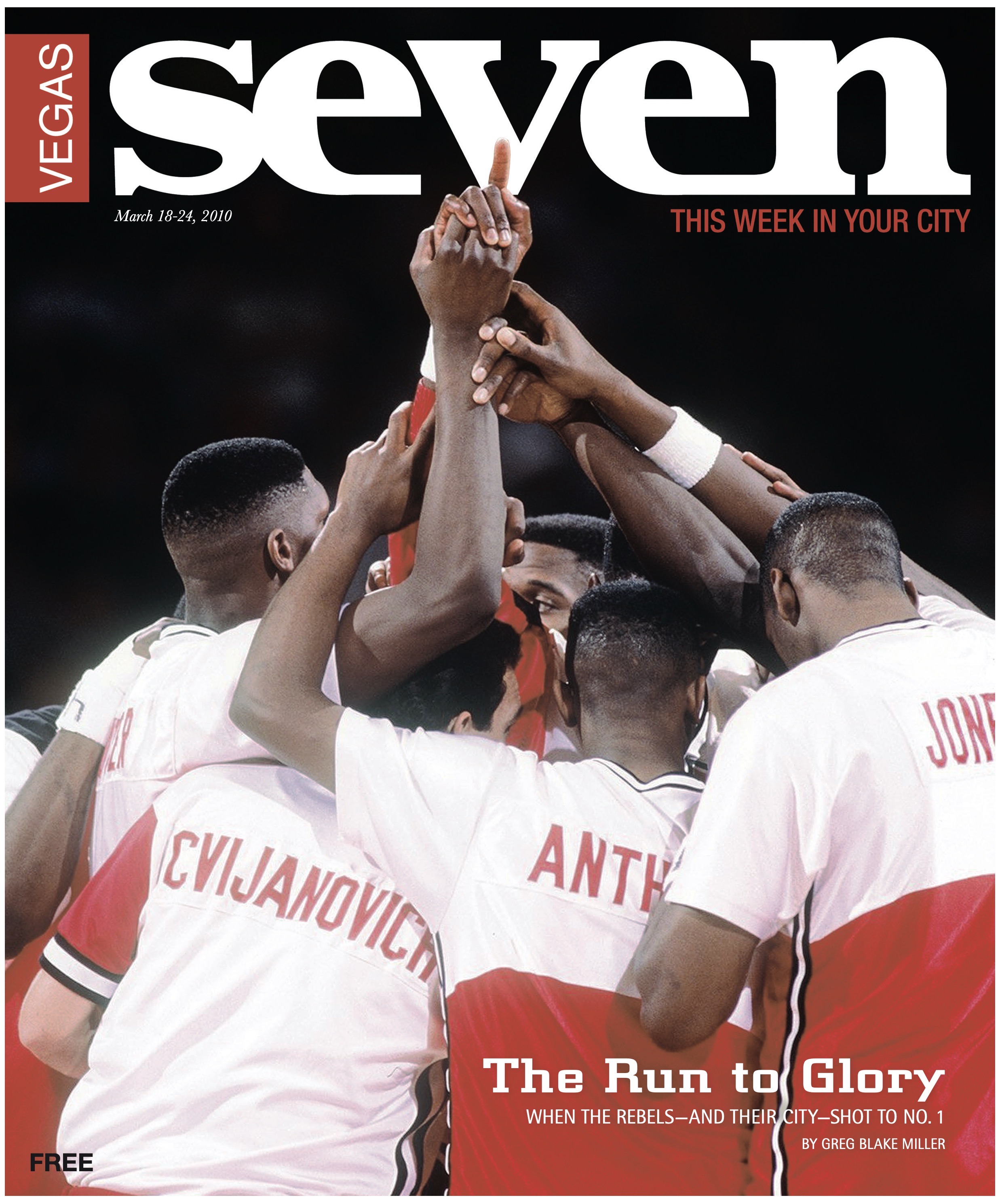
(I wrote this story for the March 18, 2010, issue of Vegas Seven Magazine to mark the 20th anniversary of the UNLV men’s basketball team’s 1990 NCAA championship run. To see the original layout, click here.)
The Rebel Alliance
A team, a city, and a dream of electric togetherness
By Greg Blake Miller
Anderson Hunt dropped 36 points on the Soviet National Team. Gorbachev did not intervene. The Berlin Wall fell. Maybe it’s age: The newsreel of that autumn is full of strange jump-cuts and garbled headlines and conspiracy theories from the pages of Lewis Carroll. It is, of course, unlikely that the Soviet team’s visit to America’s most American city ended the Cold War. But theories of public diplomacy and the butterfly effect leave the possibility open. The game took place on Nov. 7, 1989, the 72nd anniversary of the Bolshevik Revolution. The University of Nevada, Las Vegas men’s basketball team won, 107-102. That was on a Tuesday. By Thursday a host of happy hooligans had scaled the wall and started chipping at the concrete.
I was in California, 19 years old, studying to become an expert on the Communist Bloc. My Cold War career was going up in smoke, but it was worth it: A thousand bitter disappointments, it turned out, could be cashed in for one great triumph. I thought it was the most optimistic autumn since 1945, and when I visited my hometown of Las Vegas everyone seemed to agree with me. All I had to do was talk basketball.
Larry Johnson. Stacey Augmon. Greg Anthony. Walk into a room. Say the names. Everyone smiles at you. That’s Las Vegas in November of ’89, when the adventure began. For 15 years Las Vegans had made the UNLV basketball team the avatar of their civic hopes. We were experts in the peculiar American logic of urban legitimacy: We’re a real city. Look at our team. But the national voices kept harping on Tark’s sharkiness and calling our team “NeVAHdah-Las Vegas.” We protested, to no avail, that neither the mispronunciation nor the hyphenation was really necessary. After two agonizing Final Four losses (’77 and ’87) and a decade-and-a-half hovering in or around the top 20, we all understood that nothing but an NCAA title would liberate us from a national press that insisted on using gambling metaphors when discussing David Rice’s haircut. We wanted to climb a wall and shout to the world that we were not hooligans after all.
Las Vegans felt young that year. We were the raw kid conquering gawkiness, the one fighting for full possession of his gifts. Steve Wynn opened his Mirage just as the basketball season began. The stagnant days of seedy ’70s “carpet joints” were fading. The words “world class” may ring oddly hollow 20 years and a Great Recession later, but back then they were a badge of self-determination for Vegas Nation. We were not a tourist town but a world-class city that happened to put on a hell of a show for tourists.
The Rebels, though, were our show.
The revolution had begun.
For a moment, it seemed like it would last forever.
★ ★ ★ ★ ★ ★ ★
Six minutes and 19 seconds into a game on Feb. 12, 1990, Anthony, who held the dual posts of point guard and spiritual leader for the 19-4 Rebels, collided with Fresno State guard Wilbert Hooker. Anthony then fell face first on the hardwood. His jaw broke in two places. Stacey Cvijanovich, a steady senior reserve, entered the game and promptly separated his shoulder. The Rebels, who had scored 100 points in five of their last six games, held on to beat the Bulldogs, 69-64. That night, doctors wired Anthony’s jaw shut.
Three nights later, New Mexico State, which was 20-2 and had earlier beaten the Rebels, 83-82, in Las Cruces, arrived at the Thomas & Mack Center to play a Rebel team that, to all appearances, no longer had a point guard. Fireworks burst beneath the Shark Tank rafters. Spotlights roamed the sellout crowd. Veteran public address announcer Dick Calvert announced the starting lineup: At point guard, a 6-2 junior from Las Vegas, Nevada …
Read more…In the Cards
The highway billboard account account of the first months of Donald Trump’s second term in office would require only five short words: his proclamation to Ukrainian President Volodymyr Zelenskyy, “You don’t have the cards.”
Americans should picture themselves in Zelenskyy’s seat, because that’s Trump’s message to all of us: He has the power, we do not, and he will do with us as he pleases.
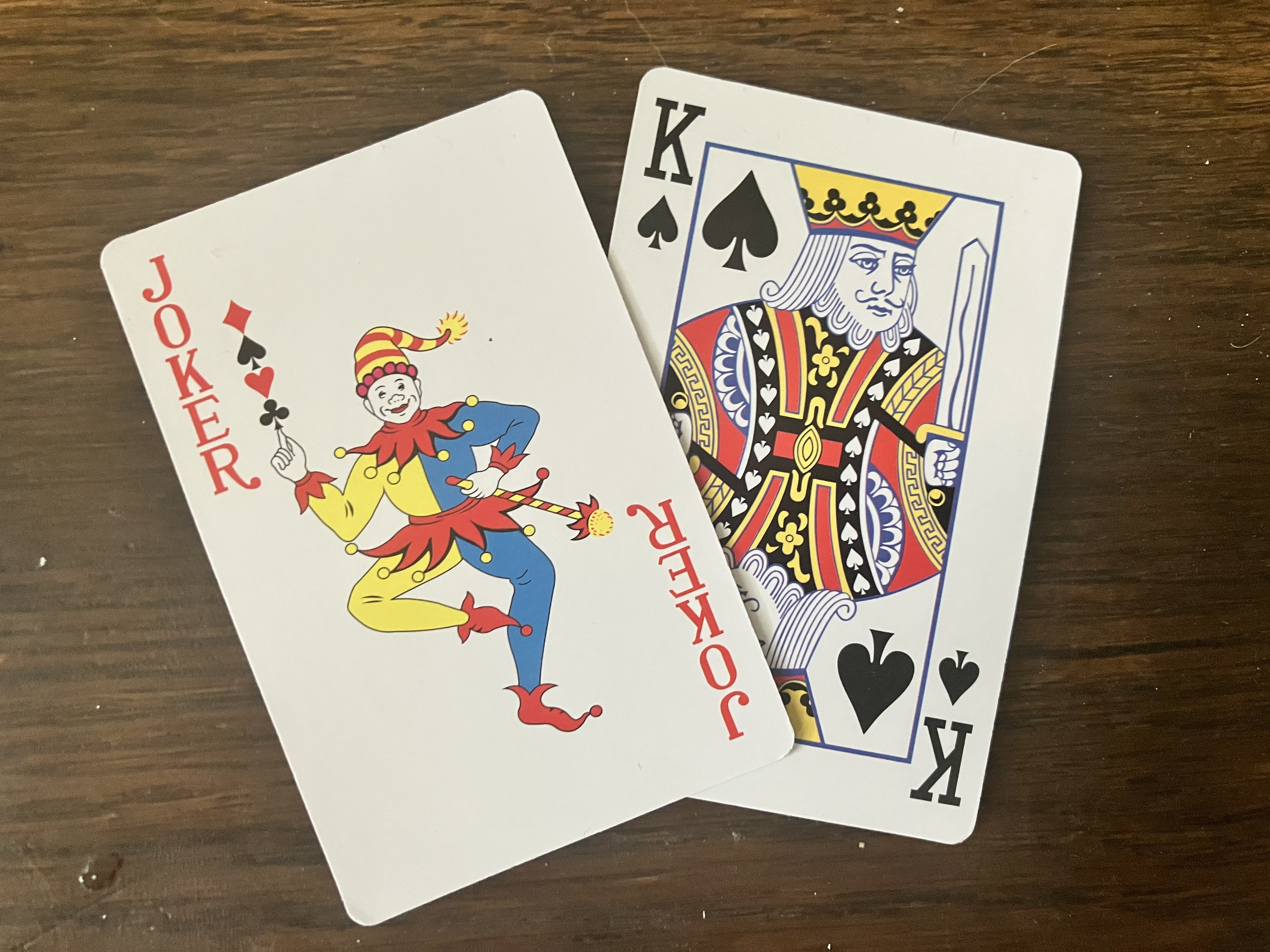
If you think you have the cards, be honest with yourself: What cards do you actually have? The truth is that most of us, no matter how hardworking or bright we might be (or think we are), do not actually have any cards. At most, we’re holding a Jack and a 9 at the blackjack table and asking Trump to hit us.
Oh, he’ll hit us alright. And then he’ll take the pot. The guy’s had 21 practically from birth, the perfect mix of means, enablers, and ruthlessness.
We grow up thinking that we either have the cards or that we’ll make them for ourselves. But this is a misinterpretation of the American dream—which proposes that if we work hard, we will find a valued and reasonably rewarded place in a just society built on institutions that protect our freedom and, within certain broad parameters of mutual respect and responsibility, self-determination. The American dream is not the promise of total unfettered license to trample everyone around you in pursuit of your goals. Moreover, the American dream becomes almost impossible in the absence of the institutions of trust, competence, and confidence—built over decades and centuries—that structure and protect American liberty. In the absence of these institutions, and of the values behind them, life—as Hobbes said of the state of nature before governance—becomes “nasty, brutish, and short.”
Ironically, the only defenses an individual has—that is, the only defenses of the individual’s individuality!—are (1) shared values as expressed in government, culture, and collective action, and (2) revolution. But the history of revolution is long, bloody, and mostly sad. So we’re left with our personal independence being dependent on just government, which is precisely what Trump trying to destroy. And right now, he has the cards.
When you read headlines proclaiming Trump’s “expansive interpretation of executive power” under the Constitution, don’t be fooled. This administration isn’t trying to interpret the Constitution, but to do away with it. They will still wear their “We the People” hats and tattoos, but they are not the people, and they have no interest in any of the words that follow anyway, least of all “provide for the common defense, promote the general welfare, and secure the blessings of liberty for ourselves and our posterity.” Nor do they believe in the Pledge of Allegiance they claim to hold so dear. Do they really belief in “liberty and justice for all”? The words “for all” are, to this administration, nothing more than creeping communism.
And in any case, this is an administration that has the specific aim of deleting the very notion of justice, and replacing it everywhere with “retribution.”
The cards have been dealt, the former rules of the casino have been suspended, and the emerging America has reconstituted itself as the new state of nature, a land of social Darwinism (but creationism in the schools!), one nation, under God, infinitely divisible, with nastiness and brute force against all.
It’s time to shuffle the deck, to rebuild and reinvigorate the institutions of liberty and justice—both inside the government and out—before it’s too late. Let’s get together to think, dream, devise, and act. The only cards we have are one another.
– GBM, March 20, 2025
Land of the Broken
(An update in rap from the American gurney …)
Sheet pulled neat
Over face, past feet
Tie a tag to the national toe
Got the blues from the news
And I want to hit snooze
But I know just where to go
Sky hangs high
We’re the same in its eye
And they haven’t cut its budget yet
Hit the trail
Feet don’t fail
Peace of mind is the grail
Gonna see how far I get
Land of the broken
Free from the job
This one’s a token
That one’s a slob
I’m looking for the sense in the mess on the floor
Looking for the keys but I can’t find the door
Thought it was forever
But it never was for sure
Cut loose from my tether
Can’t fly anymore
I’m a thousand miles from CPAC
But the blade still cuts
Thinking positive like Deepak
But I’m falling into ruts
Got my self together running right
After all these years
Pulled my mind from darkness into light
Walking through my fears
Just another man, I’m doing work
Living it with love
And I learned where all the demons lurk
You know they’re up above
They got castles in the valley
They got castles in the sky
They got cameras in the alley
In your room they got a spy
They’re calling out for words
That I’m not gonna say
Their revenge of the nerds
Can wait another day
I got words of my own
I got bite in my jaw
Got my wild oats sewn
Got my fatal flaw
They can cut me loose
Kick me out of my shell
They can knot up the noose
But I’ll see them in hell.
– GBM February 24, 2025
The Head of America
The air is sick with byte and wave
Pre-empting every thought
Hate and covet, whine and crave
Become what you are not
It comes in through the eye and ear
It oozes through the skin
It tells you who to loathe and fear
It redefines all sin
Love thy neighbor?
Well, depends on who thy neighbor be
The stranger’s in our midst, they say,
Yearning to breathe free,
Wretched refuse, huddled mass,
From asylum gates they pour
Madmen from the underclass
Storm the golden door.
Asylum sought
Asylum not
Asylum caught
Asylum shot.
The only good stranger, say the waves and bytes
In the disrupted Head of America,
Is a dead one.
But I, too, was once a stranger in the land of Egypt.
And my days, too, are numbered.
– Greg Blake Miller, 2-10-25
“The Kuleshov Effect” (“Эффект Кулешова”): The Novaya Gazeta Review

Two days before Thanksgiving, I woke up to yet another reason for gratitude: A review of the Russian-language version of my novel, The Kuleshov Effect (“Эффект Кулешова”), had run in the great dissident newspaper (now operating in exile) Novaya Gazeta. The review was written by Andrei Khrzhanovsky, one of Russia’s greatest animators, who had gone to film school in the 1960s with many of the real-life figures who populate my novel. At the center of my book is the ingenious, mercurial, often joyful and ultimately tragic screenwriter Gennady Shpalikov. Khrzhanovsky was close friends with Shpalikov, and Shpalikov wrote Khrzhanovsky’s beautiful, almost hallucinogenic first film, There Lived Kozyavin (1966), as well as his second film, The Glass Harmonica (1968), a surreal allegory of greed, power, and the healing capacities of art. (The Glass Harmonica has now become a world classic, but only after it was banned for two decades.) In other words, Khrzhanovsky lived the worlds that I could only imagine and knew the people I could only re-invent. So his words are particularly dear to me. I have translated Khrzhanovsky’s review into English in the PDF below.
First, I also want to say a word about Novaya Gazeta, which for decades has been one of the great endangered bastions of true journalism in Russia, questioning power in the face of increasingly draconian repression. Mikhail Gorbachev was one of the newspaper’s owners; the great investigative journalist Anna Politkovskaya—who was murdered in 2006 for her truth-telling—was one of Novaya’s star reporters; the newspaper’s former editor, Dmitry Muratov, won the 2021 Nobel Peace Prize. After Russia launched its full-scale invasion of Ukraine in 2022, which Novaya Gazeta denounced, the paper was forced to move its operations to Riga, Latvia. There it has continued its tradition of boldness, critical thinking, and professionalism in its reporting about Russia, the war, and the world. Novaya Gazeta has also continued to serve as a island of safety and sanity for the best of Russian culture, carrying on the centuries-old tradition of the opposition intelligentsia not only in journalism, but also in literature and the arts. As a longtime journalist, magazine editor, and journalism teacher, I am awed and inspired each day by the work Novaya Gazeta does, and I am proud and humbled to have been mentioned in its pages.
I hope in the coming months to decide on an English-language publisher for The Kuleshov Effect. It’s odd, of course, for a novel to have been released first in translation, but it’s also somehow appropriate that my story should come first to those who knew its heroes, whether through their art or, as in Khrzhanovsky’s case, their direct friendship. I’m extremely grateful to the outstanding exile press Freedom Letters—as well as to the brilliant writer Dmitry Bykov, who championed the manuscript, and Ekaterina Kevkhishvili, who translated it beautifully—for the opportunity to share The Kuleshov Effect with Russian-language readers around the world.
Here is the translation of Andrei Khrzhanovsky’s review …
The Kuleshov Effect (“Эффект Кулешова”) … Behind the Interview
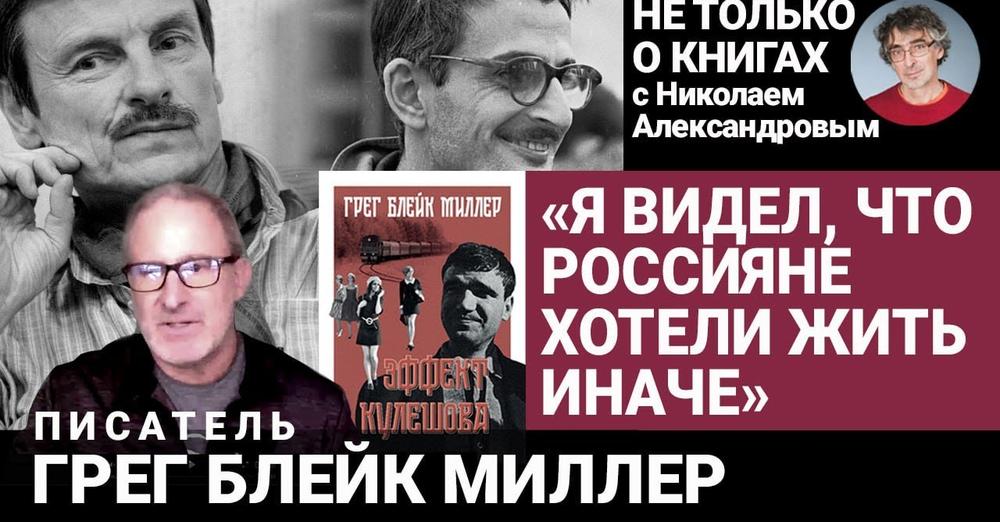
(Click here to watch the interview in Russian on YouTube.)
Last week, I was invited for an interview about my novel, “The Kuleshov Effect” («Эффект Кулешова»), with the outstanding Russian exile literary critic Nikolay Alexandrov. Nikolay’s show, “Not Just About Books,” is part of the YouTube channel “The Insider Live”—itself part of a remarkable dissident communication infrastructure cobbled together outside Russia by exiles in the wake of Putin’s war and repression.
I was nervous, naturally: a full hour in Russian taking questions from a very smart guy before an online audience that was probably wondering why on earth this American dude from Vegas has published a novel in Russian about the great cultural heroes of the Soviet Sixties, a time both heroic and tragic, when a seductive glimmer of hope and freedom appeared in the wake of Stalinist darkness … and then faded.
The interview was to be recorded Sunday morning and aired on Tuesday. I practiced on Saturday afternoon between stomach aches and then again very early on Sunday and then logged in for the Zoom call with Nikolay, who was in Europe, and the sound engineer in Tbilisi. Nikolay asked his first question and, as sometimes happens in sports, all of my tension went away and I was suddenly in a flow state, the proverbial “zone”. My Russian was still, of course, imperfect, but it felt (improbably, ten years after my last visit to Russia) like the best I’d ever spoken. Whatever corner of my brain I’d trained not just to speak a language but to BE in it had taken over.
And then, 50 minutes into the conversation, the sound engineer broke in:
“Guys, I’m very sorry, but the lights just went out in Georgia, and we lost the entire recording.”
Deep breath. Well, three deep breaths—mine, Nikolay’s, and the sound engineer’s.
I was given a choice to redo the interview later that day, sometime the next day, or, if I wanted, right now. I chose now.
I took a five-minute break, got a glass of water, rearranged my set-up because the sun was now blasting through my blinds and leaving strange stripes on my face, took yet another deep breath (you’ll see more of those in the video; one commenter wrote, “Greg even exhales in Russian”) and we began anew.
The result is posted here: My Russian was not nearly as clean, but I still was in the moment, being a Russian speaker rather than merely speaking in Russian. Sometimes my brain paused and buffered, but ever since my cage fight with Covid in 2020 it does that in English, too. And, toward the end of the show—the end of my second hour of being interviewed—I got tired … like, runner-at-marathon’s-end tired. At one point I rubbed my eye under my glasses, leading a conspiracy-minded commenter to ask what such a gesture symbolized. (I will tell him: Scratching my eye was a symbol for the fact that my eye itched.)
Nikolay was a remarkably good interviewer, insightful, challenging, empathetic, patient. His final question was a challenge to my linguistic subtlety and moral clarity: What would I want to ask of or say to contemporary Russian society?
Time was short, and I decided to speak not to those who have fallen in line with Putin’s war but to those left behind, trying to sustain life and hope while living under the suffocating weight of a government that has sacrificed the better angels of Russia’s nature on the pyre of national resentment, political opportunism, imperial delusion, and plain bloodlust.
I said that I know that the seed and spark of all that is best in Russian (and broader post-Soviet) culture remains, that kindness and humanity remain, that I know that these traits are aching to be seen and heard. I said that I have hope, a painful, halting, but real hope, that they will indeed be seen and heard. The kindness and genius I encountered among friends when I worked in Russia in the 1990s and among historical figures while I was researching the filmmakers of the 1960s for my dissertation and later for “The Kuleshov Effect” lives on, battered but but not fully defeated.
I am a romantic, of course; my brain senses the depths but my heart always insists there’s a way out. Within the course of my life, I said, we will see a better day. This, I said, is not simply my hope; it is my conviction.
 Reentry Shock