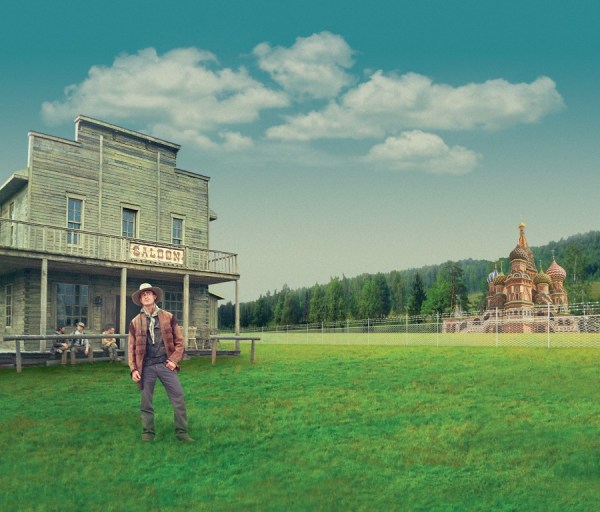
Reentry Shock—The Dissertation
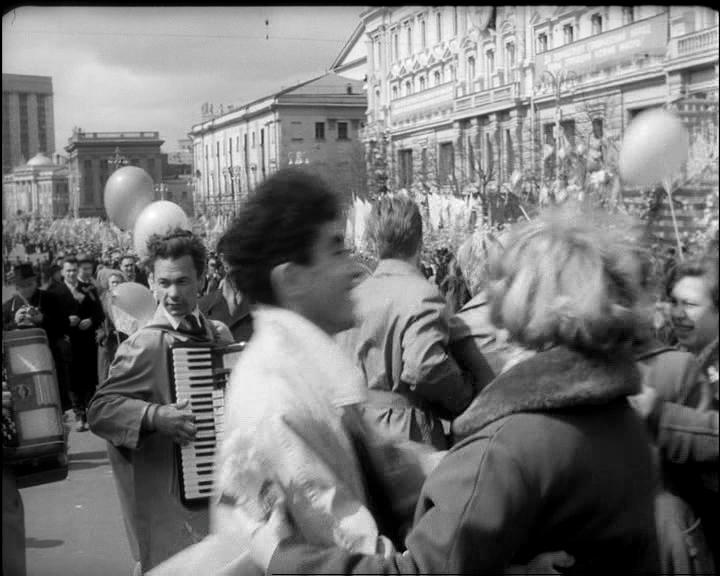
From Marlen Khutsiev’s “I Am Twenty” (1961/65)
Reentry shock: Historical transition and temporal longing in the cinema of the Soviet Thaw.
By Gregory Blake Miller, Ph.D., University of Oregon, 2010, 323 pages.
Abstract: Nostalgia is the longing for a lost, and often substantially reimagined, time or place. Commonly regarded as a conservative impulse available for exploitation by hegemonic forces, nostalgia can also be a source of social questioning and creative inspiration. This dissertation examines the ways in which nostalgic longing imports images and ideas from memory into present discourse and infuses works of art with complication, contradiction, and ambiguity.
In the early 1960s, emboldened by Nikita Khrushchev’s cultural Thaw, many Soviet filmmakers engaged both personal and social memory to craft challenging reflections of and responses to their times. These filmmakers reengaged the sundered spirit of the 1920s avant-garde and reimagined the nation’s artistic and spiritual heritage; they captured the passing moments of contemporary history in a way that animated the permanent, productive, and sometimes stormy dialogue between the present and the persistent past.
Mikhail Kalatozov’s I Am Cuba (1964), Andrei Tarkovsky’s Andrei Rublev (1966, released 1971), and Marlen Khutsiev’s The Ilich Gate (1961, released with changes in 1965 as I Am Twenty ) were planned in the anxious years surrounding Khrushchev’s fall, and the films mark a high point of Thaw-era cinematic audacity. Each film is epic in scope; each deploys temporal longing to generate narrative ambiguity and dialogue between historical epochs. The films are haunted by ghosts; they challenge the hegemony of the “now” by insisting on the phantom presence of a thousand “thens”; they refurbish old dreams and question contemporary assumptions.
The Thaw permitted the intrusion of private memory into public history, and the past became a zone for exploration rather than justification. Easy answers became harder to come by, but the profusion of questions and suggestions created a brief silver age for Soviet cinema. For us, these films offer an extraordinary glimpse into creative life during one of the great, unsung social transitions of the 20th century and reveal the crucial contribution of individual memory in the artistic quest for formal diversity, spiritual inspiration, and ethical living.
[Dissertation available for order from UMI Dissertation Publishing/ProQuest Dissertation Express.]
Kalatozov’s “I Am Cuba” and the Search for Leninist Faith
Soviet filmmakers Mikhail Kalatozov and Sergei Urusevsky were just beginning their artistic careers when the Stalinist command system eradicated the chaotic cultural spontaneity of the Soviet 1920s. Under the evolving principles of Socialist Realism, the avant-garde habits of formalist exuberance and participatory creative revolutionism were replaced by the signal virtue of “party-mindedness”—a mental state best measured by one’s fraught adherence to a shifting Party line. The heroic period of Soviet art had come to an end, but it left a phantom trail of aesthetic and spiritual inspiration that decades later would help shape the great works of post-Stalin cinema.
In their 1964 film, I Am Cuba, Kalatozov and Urusevsky implicitly hold the lost spirit of the Soviet 1920s up to the mirror of late 1950s Cuba. They look longingly upon the idealism of the Cuban revolutionaries and the shimmering surfaces of the erstwhile bourgeois city and ask: Can we believe like revolutionaries, produce like capitalists, and share like socialists? Can the Soviet Union deliver on the Russian Revolution’s promises of purpose, justice, and plenty? Cuba, alas, offers inspiration without answers, and the filmmakers—like their 1920s predecessors—wander beyond ideology into a sort of phenomenology of seeing. Revolutionary outcomes remain a mystery, but revolutionary art endures as a palliative pleasure and an emissary of hope.
Kalatozov and Urusevsky understood well that socialist modernization belonged to the category of faith. The technical fetishes of the 1920s, the militant atheism, the loudly proclaimed search for “scientific” solutions in everything from economics to poetry, were all part and parcel of a young faith, a search for ecstatic self-transcendence; the manifestos of 1920s artistic groups read like shamanistic incantations: there is a worshipful primitivism underpinning the future-worship of young post-revolutionary leftists. Dziga Vertov’s Kino Eye group called for “the emancipation of the camera, which is reduced to a state of pitiable slavery, of subordination to the imperfections and thes hortsightedness of the human eye,” and went on to declare their allegiance to “the camera as a kino-eye, more perfect than the human eye.” (Michaelson, 1984, pp. 13-14)
This spiritualization of Leninism had deep roots. For many Russians, the Communist promise of an eventual utopia beyond labor and the tyranny of rational time was a renewal of a complex of ancient, unsinkable millennial hopes sometimes summed up as “The Russian Idea.” During the 19th century, Russia’s great intellectual debate was between those who advocated a Western path of development—the Westernizers—and those who believed that Russia had its own path, based on the Orthodox ideal of conjunctive togetherness and the values of the peasant commune —the Slavophiles (Riazanovsky, 1965). In Weberian terms, the Westernizers believed in a rational-legal basis of socio-political legitimacy, while the Slavophiles preferred a mix of traditional and charismatic legitimacy (Hanson, 1997).
The genius of Soviet Marxism-Leninism lay in its ability, as an atheist ideology, to somehow co-opt the idealism of both rational-legal Westernizers and charismatic-religious Slavophiles and create a new faith that promised to redeem Russia. Communism was a supra-national ideology of modernization, but its appeal lay in its connection with national myth: the new ideology would allow Russia to fulfill its prophesied role as the “Third Rome”, the leader of the world, at once exceptional and exemplary, and to create an entirely just, secularly holy society. Within the early Communist movement there was even a group of writers and thinkers who called themselves the God Builders and wanted to make the ideology’s implicit religious parallels explicit. Lenin was not amused, though he did make one of the leading God-Builders, Anatoly Lunacharsky, his first Commissar of Enlightenment.
The Stalin era replaced the unifying ideal with the unifying leader, and replaced enthusiastic quasi-religious participation in the process of Communist modernization with compulsory, quasi-religious obedience to the word of the master. The nostalgic connection with the ancient Russian dream of sobornost’–an organic, cooperative togetherness in which individual expression and community goals are mutually supportive—was severed. The Stalin synthesis made it clear that the path to progress necessitated the effacement of self. Stalinist modernization was new without offering renewal. While convincing arguments have been made that Stalin’s program was the logical next step in the unfolding and realization of the logic of Marxism-Leninism, the culture of high Stalinism, from the mid-1930 until his death in 1953, could not be more distant from the chaotic cultural energy of the Soviet 1920s.
And it was precisely this energy, more than even the most hopeful interpretation of Lenin’s voluminous written record, for which the post-Stalin intelligentsia—the communicators—was nostalgic. It would be their job to return the energy of Leninist modernization theory to their own countrymen—to make of their country an inspirational beacon for countries around the world. By the end of the 1950s, Russians were prepared to revisit the Revolution and reinvigorate their revolutionary idealism. The Cuban Revolution offered a perfect transnational metaphor. As Genis and Vail (1996, p. 59) write, “The Cuban Revolution became a metaphor not only for the October Revolution, but for its contemporary reincarnation—the liberal, Thaw revolution of the 1960s.”
—Greg Blake Miller
The Haunted Hero of Bondarchuk’s “Fate of a Man”
The object of nostalgia in Sergei Bondarchuk’s Fate of a Man (Sud’ba Cheloveka, 1959) is the hovering, tantalizing, maddening reality of a pre-war world. The image of this hopelessly lost terrain refuses to yield; it lingers in the mind as a promise and a torment. Andrei Sokolov (Bondarchuk), an escaped prisoner-of-war, has lost his entire family in the Great Patriotic War. For him, the past is more real than the present. He embraces the torments of recollected wholeness. We might guess that such memories would preclude Sokolov’s engagement with a present that is, for this bravest of men, unpeopled, undesirable, and even frightening—an empty map from a book about journeys one would rather not take.
But it is precisely the survival of memory, of the image of a longed-for past, that motivates Sokolov’s first, audacious step toward a workable future. Sokolov had once defined his peacetime identity by his love for family; he had become a husband and father in the brief era between the twin upheavals of forced collectivization and total war. Peace without family is for him a kind of grim joke. He can conceive of forward motion only through an echo of the past. He finds it in a tiny, towheaded orphan-beggar named Vaniushka.
After giving Vaniushka a lift in his truck and learning that the boy has also lost his entire family, Sokolov turns to the child.
“Do you know who I am?”
“No.”
“I am your father.”
The child throws himself upon Andrei with kisses and tears, and together they set off on a journey into the unknown, each holding close a phantom of a lost past to steady, direct, and sustain them on their way.
The union of these two lost and longing souls leaves some crucial questions to be resolved in the post-film world of the viewer’s mind: Will Andrei attempt to raise the boy as a replacement or reincarnation of his lost son (an expert mathematician and heroic wartime captain)? Or will he focus his longing not on the impossible return of a departed son, but on the very real prospect of having a new one—of experiencing anew the longed-for feelings of family commitment. In short, will he help the boy toward a future of his own?
The imagery of the film itself—Sokolov’s close attention to the boy as an independent and proudly self-aware creature (note the boy’s prickly greeting of the driver at the film’s beginning) seems to bode well. But when the words of Mikhail Sholokhov (upon whose writing the film is based) appear on the screen at film’s end, they strike a dissonant note. After a tale that so boldly exposes the horror of war rather than trumpeting its glories, Sholokhov’s words pose the question of Vaniushka’s future as a purely martial one: Will Andrei raise a boy capable of going through what Andrei went through for his country? This is sheer ideological overlay, imposing final thoughts on a film that did quite well on its own in provoking thoughts.
Of course, it occurs to us that a father who has been so extraordinarily strong in the most beastly of circumstances, and yet lost none of his capacity for tenderness, may raise a brave and honorable son. But we have more fundamental worries about the future of Andrei and Vaniushka: Sokolov remains deeply damaged and far from recovered. At night, he tells the driver, he worries he’ll have a heart attack and die and frighten the child. He still laments, reasonably enough, that his life has been twisted and ruined. It is clear that Sokolov will need the boy as much as the boy needs him, and that the fathers and sons debate that will unfold during the Thaw years (who will teach whom?) is, as in reality, unresolved. Least of all are we concerned about how the child will grow up to serve the nation. Our concern is simpler. How will he grow up?
In this film, pain is not elegiac but raw, more realist than neorealist. Bondarchuk, as Andrei Sokolov, is not quieter than life like the heroically observant Alyosha Skvortsov of Chukhrai’s Ballad of a Soldier (1959) or the suffering thinker-heroes of Tarkovsky’s films. He is, instead, intense and forever battling, a man in motion both physically and mentally. This motion of his mind projects onto his muscles, his jaw, his stride. He is, like the best creations of Brando or Steiger, filled with despairing rage and fierce despair. To this he adds an awkward gentleness, a halting language of hope, sustained and challenged by ghosts.
—Greg Blake Miller
Kalatozov’s First Masterpiece

Mikhail Kalatozov, the renowned director of the classic Soviet films The Cranes Are Flying (1957), The Unsent Letter (1959), and I Am Cuba (1964), had his cinematic roots in the vibrant creative ferment of the Soviet 1920s. At decade’s end, after learning his craft from the great documentary filmmakers Esfir Shub and Dziga Vertov, Kalatozov brought his camera to a Georgian mountain community where the routines of both subsistence and spirit had changed little since medieval times (Leyda, 1983). There he created one of the masterpieces of early Soviet cinema, Salt for Svanetia (1930).
Like many great Soviet films of the 1920s, Salt for Svanetia bears thematic richness within an agitprop libretto. On one hand, the film, exuberantly modern in its rhythmic editing and oblique camera angles, calls for socialist modernization (in this case, for road construction) as the guarantor of a more humane way of life. On the other, it is a hymn to communal timelessness. This paradox reflects the peculiar temporal ambivalence at the heart of both early Soviet cinema and early Soviet populist-enthusiast dreams of modernization. By 1930, as the midpoint of the First Five Year Plan approached, the half-romantic notion that modernization could be achieved without trampling the communities the state sought to modernize was on its way out. But in cinema the old dream was exiting with an extraordinary flourish, highlighted by Kalatozov’s film, and still more famously by Dovzhenko’s Earth. In Salt for Svanetia, the pre-industrial struggle for daily life is so lovingly depicted—even in its tragic moments—that it becomes impossible to read the film as an uncomplicated call for ends-justify-the-means industrial progress. (Thirty-four year later, Kalatozov would revive the 1920s populist-enthusiast synthesis in I Am Cuba.)
Salt for Svanetia, like Earth, refuses to look forward without simultaneously looking back. The intellectual inheritance of the Soviet revolutionary spirit mixes the utopian, past-denying forward thrust of Marxist modernization with the back-to-the-people dreams of the 1870s Russian narodniki, populists who both idealized the peasant commune and sought to transform it through literacy and political consciousness. If, under conditions of capitalism, holiness had melted into air and the sacred had been profaned, the dream of the Socialist modernizer was not to mock the sundered spiritual instinct, but to renew and repurpose it.
—Greg Blake Miller
Wild Dog Dingo (Dikaia Sobaka Dingo, 1962, dir. Yuli Karasik), is one of the most striking examples in Thaw cinema of the way neorealist nostalgia penetrates social frameworks and cuts a path to the looming, haunting, bittersweet personal past. The film does not willfully ignore social themes and the life of the nation; it just finds them beside the point when more pressing matters are in question.
Through the eyes of the film’s teenage heroine, Tanya, played by Galina Polskikh, we experience the phenomenon of childhood’s end—the magical thinking of youth, the sense of frightfully shifting ground, the longing. A tree waves in the schoolroom window, seeming to beckon to Tanya. She asks to change seats. “The tree is distracting me,” she says. The teacher looks at her, perplexed. “It’s just an ordinary tree. What’s with you?” At night, in her bedroom, Tanya looks out the window, pinches a star between her thumb and forefinger, cups the moon in her hands. Here, on the verge of adulthood, she is taking the imprint of her childhood mind, both saying farewell and saving it forever.
There is an air of tantalizing hauntedness hovering before her even in her seemingly lightest moments. At the end of the school day she slaps portfolios with a classmate in a Russian version of a farewell high five and then turns to the empty, windswept road. Less than a second has passed and the mood has changed keys from major to minor and the enchanted air of the village has acquired a heaviness, a strangely pleasing bitterness. The sudden change of mood, the heightened perception of the world and the extraordinary rapidity with which this perception translates to affect—is this not what we both lament and cherish in our teenage years, the uncanny pleasure-pain of it all? Here Karasik has taken us beyond any pose of “social independence” and into a terrain of of pure subjectivity. A girl’s life is carved from the matter around her by the intensity of her own perception, her own magical thinking, the stuff of her own memories of fast-fading childhood and the father who has long-since left and now, on this day, is to return.
The film is dominated by Galina Polskikh’s eyes, by her constant perception, searching, wondering, remembering, reassembling, weighing of the evidence of matter and memory, dominated by her longing for what has been lost before and what continues to be lost now, what must therefore be fully taken in, fully seen, while the moment lasts.
People here are, if anything, more silent than in real life. And the silence leaves room for richer perception of time. When Tanya’s father, having returned from the city to the village, speaks to her, she says, “You don’t have to speak so loudly. I hear you quite well.” The country and the city have both different volumes and different time sensibilities, but it is all too easy to see silence and lack of environmental transformation as stasis. “It’s amazing how everything has changed in the city,” says Tanya’s father, “and back here everything’s the same as it ever was.” Tanya’s mother, the woman he left, replies flatly: “Yes, same as it ever was.” She says this with pain and hope and awareness of her own artifice. Things are not the same as ever. For one thing, years have been lived without a husband, a father. A little girl has grown up: the father himself has just looked upon his daughter with astonishment: “You’re so big!” Life never remained unchanged, not for a minute. Tanya’s mother excuses herself and goes to the kitchen to make tea. “I should have brought you flowers,” Tanya’s father says to her. He reaches into the pocket of his military dress blues and produces an oval box of candy. He hands it to her, embarrassed to have missed all that he has missed, the time that can be longed for but never regained. One cannot even remember what one has missed. A clock ticks in the background.
After three years away, Tanya’s father is now anxious to join in her life. He has brought an adopted son, Kolya, along with him, and though the families will not merge, he would like them to get along. He understands that micro-changes, the changes you don’t see in the layout of a town’s lanes but in the lives of its inhabitants, are the real dynamism, the things one must see or regret not having seen, the matter that is most essential to the shaping of intimate memory. As he meticulously prepares pel’meni, Russian dumplings, Karasik’s camera stays with him through the entire process. (The scene brings to mind the famous morning-in-the-kitchen scene in DeSica’s 1952 Umberto D.) On the left side of the screen, Kolya is talking to Tanya’s mother, who is offscreen.
We do not see Tanya in the scene, but she is a looming presence. We know those eyes; we are watching with those eyes, watching for her, taking in the moment, measuring the weight of the world.
—Greg Blake Miller
Opening the Code: Scripting, Sincerity, and the Soviet Thaw
In December 1953, just six months after Stalin’s death, the Moscow-based literary journal Novy Mir published a series of essays by Vladimir Pomerantsev titled “On Sincerity in Literature”. Pomerantsev criticized the “varnishing” of reality; literature, he wrote, could no longer avoid reflecting and contending with “the vulgarities of life” (Zubok, 2009). Pomerantsev’s watchword, sincerity, was taken up by a generation of Soviet artists. In cinema, its great champion was the filmmaker Mikhail Romm, who as a professor at the State Cinema Institute (VGIK) openly encouraged his students to be themselves—to process and portray the world according to their own perceptions and in tune with their own sense of artistic integrity . The ethic of sincerity required not simply that one be oneself, but–a far more difficult thing–trust oneself.
Suddenly, one’s experience of the world mattered, even if that experience contradicted the world-narrative passed down from on high. If sticking to a closed cultural code meant creating works out of joint with what one saw and felt and believed, the code had to be opened. If what one saw and felt was stirringly, disturbingly complex, it would be insincere to ignore that complexity. If the drama of personal life intersected awkwardly–or did not intersect at all–with the drama of public life, it would be insincere to portray a world in which the two were harmoniously intertwined. The closed “dominant code” of postwar Stalinism was inadequate to the artist who felt a duty (both private and public) to be sincere. Sincerity required a closer look at both the internal and external world; it required the ability to see beyond imposed codes— to create a subjective response to the disorder of the objective terrain.
Stuart Hall (1974) proposed that cultural products are “encoded” according to the producer’s value-set and subsequently “decoded” by consumers. These consumers might decode the product using the same “dominant” code as the producer, creating a direct match between how the producer wants the work to be received and how it is received. On the other hand, an empowered consumer might use a different code to decipher the work, one that negotiates with the work, questioning it in some ways and accepting it in others. Consumers might even deploy an “oppositional” code that willfully reads signs against the intentions of the producer: If you write stop, I’ll read it as go. Nikita Khrushchev’s extraordinary revelation, in his February 1956 “secret speech” to the Twentieth Party Congress, of some of Stalin’s crimes (namely those committed against the Party faithful) no doubt emboldened a subset of Soviet citizens to read highly varnished Socialist-Realist depictions of, say, 1937, with an ironic or oppositional code. Indeed, by the 1970s, ironic decoding of empty Communist orthodoxy would amount to a sort of spontaneous, ongoing passive resistance to the more marked absurdities of the regime—a stance not so much oppositional as creatively adaptive, a way of playing with the available toys in the sandbox (see Yurchak, 2008).
But in the late 1950s and early 60s–the post-secret speech period known as the “Thaw”–irony was not yet king. Many members of the Soviet intelligentsia took Khrushchev’s de-Stalinization campaign to heart, but they were not rolling their eyes at the communist experiment; they were searching for a way to restore the presumed purity of its roots. And they were looking for guidance and inspiration in this search. In this environment, the encoders of cultural messages played an extremely important role; in the Russian tradition artists are expected to provide not simply diversion from reality or even reflection of reality, but instruction on how to live within reality. The “accursed questions”–What is to be done? and Who is to blame?–had been tacitly assigned by the people to their artists like a particularly high-stakes homework assignment. In answering these questions, it would be unacceptable for artists to continue shaping their answers with an old code that excluded observed reality. While most Thaw-era artists did not dispense with socialist realist tropes and codes (Prokhorov, 2002), they began to change the way they way they built their word-and-image worlds upon the increasingly pliable socialist realist scaffolding. If they wanted to fulfill their cultural duty, to follow the path of Pushkin, Dostoyevsky, and Mayakovsky, they would need to open the code to worldly input.
To open a code, though, is violate its fixed nature—that is, to make it unintelligible. Without codes, life can become baggy, formless, intimidating in its chaos. Codes are the child of the narrative thinking—the habits of thought that allow us to create scripts for our world and our lives; scripts transform the ambiguous elements of life into recognizable, “priceable” commodities in the narrative economy. If our narrative tells us that X leads to Y, we can more easily deduce the worth and meaning—that is, the codified value—of X in our lives. Can we really free ourselves from this adaptive scripting, which can so often ease the cognitive burden of life?
The opening of conventional codes is, then, one of the trickiest propositions in the creation of artistic or journalistic artifacts. No representation of life is free from some sort of restrictive code. We are all hemmed in by the limitations inherent in having a point of view, and the need to impose form on a world in flux. But there is a sort of sliding scale of representation, in which we open codes up in a number of ways: one of these is to include in our representation a reflexive awareness of our own point of view; this allows us the privilege of our own script without denying the scripts of others. Another is to populate our represented worlds with multiple voices and multiple scripts, each of which are given the space for expression and integrity–the ability to enter the story, the competition among scripts. Dostoyevsky was a master at this development of multiple voices, which Bakhtin called “polyphony”. (Sarah Young (2004) offers an outstanding discussion of competitive scripting in Dostoyevsky’s The Idiot and the Ethical Foundations of Narrative.)
Seen in this light, “open encoding” is the telling of tales in which the master narrative has not pre-determined the actions and attitudes of the people and the shadings of the setting. It is an encoding in which the accidents of creation are permitted to happen. This very openness to “accidents of creation” is a sort of creative ideology. It is not an outright rejection of scripting, but an awareness that the world is composed of competing scripts, all of them operating above the unscripted stuff of nature, attempting to tame that nature, sometimes succeeding, sometimes being utterly defeated, but most often having subtle, unexpected, and even unintended consequences.
Scripting, of course, takes place not only in works of art, but in political, cultural, and individual life. We are forever creating stories about our world and ourselves. When we gather a bit of power–whether the power of an older sibling, a titan of industry, or a President–we often consider it a right, or perhaps a duty, or maybe just an irresistible temptation, to make others subject to our scripts. On the grand scale, the competitive rough and tumble of human scripting does—to borrow a phrase back in vogue—“bend the arc of history”, but rarely in a direction prescribed by any single script. (This, of course, is one of the insights at the heart of Tolstoy’s War and Peace.) Totalitarianism consists in the attempt to administratively wipe out not only the humbling underlying inaccessible truths of time and nature, but also all competitive scripting about those truths. Marxism-Leninism could posit neither humbling truths nor competitive dialogue about them. It was an attempt to install a master narrative that dictated both the national dialogue and the sketch of the world in each individual mind. This is why the late-Stalinist insistence on “conflictlessness” in cinema was the apotheosis of Communist cultural hubris. It was an authorial attempt to erase contradictory words and images from Soviet life once and for all; dialectical materialism remained the religion of the realm, but the dialectic was a museum piece, in which all contradiction was pre-scripted by the master and the synthesis was a forgone conclusion, the end of dialectics.
—Greg Blake Miller