Lives of the Non-Saints: Adventures in dystopia with Svetlana Satchkova’s “The Undead”
Lives of the Non-Saints
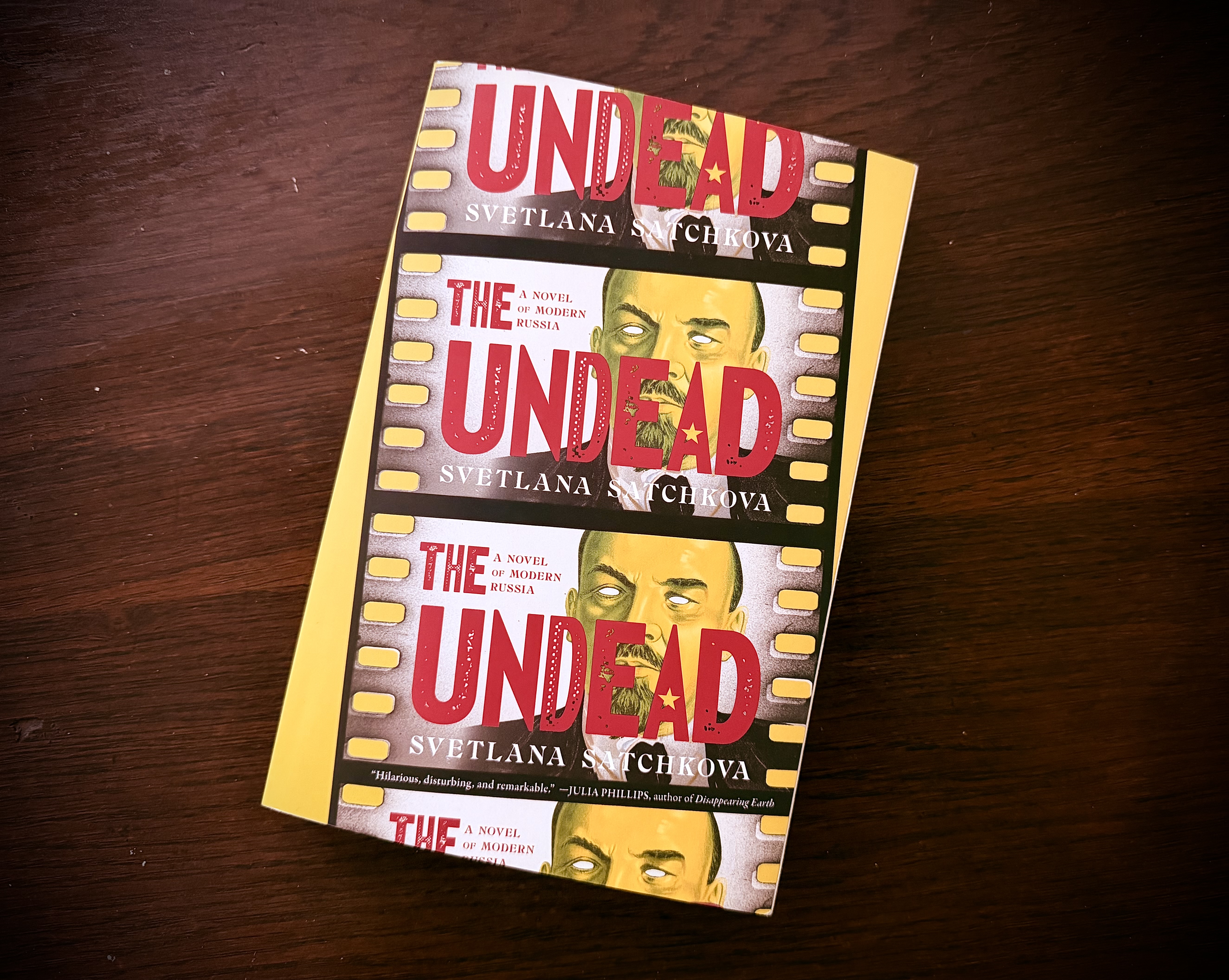
Adventures in dystopia with Svetlana Satchkova’s The Undead (Melville House, 2026)
By Greg Blake Miller
Among the lords of dystopia, certain principles are sacrosanct:
(1) The thinker must be always on trial.
(2) A guilty verdict is good, but a guilty plea is better.
(3) The not-guilty do not, and cannot, exist.
Dystopias are lands without innocents. A suspended sentence hangs in Damoclean splendor over everyone, provoking the kind of purposefully anodyne behavior that only the terrified or self-convicted can ever truly practice. This is called anticipatory obedience by some, survival by others, and complicity by the self-righteous, the recklessly brave, and the stone-throwing outsider. These are easy categories from which to recruit a Winston Smith (Orwell’s 1984), a D-503 (Zamyatin’s We) or a Katniss Everdeen (do I have to speak its name?). What you’re far more unlikely to find in the ranks of glorious dystopian heroes and antiheroes is a Maya Kotova.
Maya is the hero of Svetlana Satchkova’s new novel, The Undead (Melville House, 2026), and she is neither collaborator nor dissident nor fear-zombified faceless pillar of the Muscovite realm. She is not trying to discover or reclaim her humanity because she’s never lost it. She’s not trying to overcome fear because she doesn’t realize she’s afraid until it’s too late. She walks an arc that belongs neither to the hero nor the victim. She is, in a word, human. She errs, and therein lies the divine in this novel.
In marrying the dystopian realities of creeping 2010s Putinism with the almost cozy tropes of a young-urban-creative narrative of the same period, Satchkova manages to kill two genres with one tome. Satchkova, a Russian writer who came to the U.S. in 2016 and became—as is clear from this book—an American writer, too, joins surfaces reminiscent of the hipster Brooklyn of the Sutton Foster/Hilary Duff sitcom Younger (2015-21) with the creeping dread of a Kafkan penal colony. She not only survives the collision but emerges as the last author standing.
The Undead provides an essential window into the surreal mix of delusional normalcy, illiberal degradation, and moral bewilderment that presided in Moscow in the decade between Vladimir Putin’s return to power in 2012 and Russia’s full-scale invasion of Ukraine in February 2022. At the start of this period, the administration managed the near suffocation of an energetic national protest movement that had grown under the banner of “Russia Without Putin.” In 2014, it responded to a similar but more successful movement in Ukraine by seizing Crimea and invading the eastern part of the country. Along the way, prominent Russian dissidents wound up poisoned, dead, jailed, or run out of the country.
And yet the spirit of opposition persisted in a way that today—when an airless totalitarianism has descended—seems somewhere between quaint and miraculous: Until his 2020 poisoning and evacuation to Germany, Alexei Navalny was building his anti-corruption (read: anti-Putin) movement in Russia and presiding over the creation of daring, deeply reported and bitingly sarcastic YouTube documentaries; after Crimea was annexed, the legendary Russian rocker Andrei Makarevich released a song called “My Country Has Lost Its Mind”; massive memorial marches followed the 2015 murder of the opposition leader Boris Nemtsov. On a smaller scale, the cultural intelligentsia still gathered in cafes and spoke—more softly than before—about a parallel Russia where ideas still flowed more or less freely on the internet, daring art was still produced, opposition figures on local councils still strived to practice a sort of grassroots politics of decency, and the desire to live a normal life neither infected nor inflamed by Putinism seemed not only acceptable but admirable.
Satchkova’s Maya Kotova is a member of this café society, a Muscovite filmmaker in her mid-thirties, late to the industry but on the move, surrounded by friends, some supportive, some jealous, as she gets her first big break with a comedy-horror script about the embalmed Lenin rising from his cozy tomb to lead an army of the undead on a madcap romp through the Russian capital. To Maya, who strives to keep her nose to the creative grindstone and out of the political clouds (or the cesspool, as many Russians, with good reason, would have it), it’s just a screwball comedy. But to the cynical coworker who anonymously files a complaint, and to the authorities, who never met a denunciation they didn’t love, the film is a not only a thinly veiled attack on the Putin administration but also a terroristic call for violent revolt.
While Maya sits in court listening to the accusations, Satchkova manages a small miracle of storytelling that encapsulates the uniqueness of the novel: For a moment, Maya is less alarmed by the vicious accusation of sedition than she is by the expert witness’s characterization of her rough cut (she never gets the chance to finish the film) as clumsy and inelegant. Putin’s prison archipelago may be a fate worse than death, but a damning review is a fate worse than life. And life around here is hard enough, dammit.
This is the profound humanity of an unwitting non-saint who doesn’t realize that she’s been mistaken for Joan of Arc and that the match has already been thrown on the pyre. Dystopia, it turns out, often doesn’t look or smell like dystopia until you’re sitting before the judge. The Muscovite surfaces of The Undead are vibrant and seductive—New York without the dirt, Portland without the anarchists. Just snow, and even that’s lovely in a Moscow that has learned that the way to trick Narnians who suspect the cruel hand of the White Witch is to create a streetscape where it is not simply always winter, but also always Christmas (or New Year’s, according to the undead practices of Soviet celebration). Under the mayoralty or Sergei Sobyanin, the Moscow city center became almost sickeningly lovely, and a young and moderately successful creative like Maya has been able to circulate in semi-Bohemian circles without noticing that her life is being ideologically and emotionally geofenced by leaders who will gladly tolerate her as long as she plays the unwitting fool. But Maya is not a fool, simply a human who has not yet evolved into either the cowed or heroic personages we expect to populate a dystopia. She doesn’t get it, because who wants to get the joke when it’s so terrifyingly on us?
Through Maya, Satchkova both examines and empathizes with her countrymen—especially those with fewer means and escape routes than Maya—who still find themselves in Putin’s web. She identifies a syntactic chasm between the zombie, the collaborator, and the dissident, and plants her heroine squarely in the breach. And she reminds the stone-throwing outsider that it’s not unthinkable that we, too, may soon find ourselves on the coast of dystopia.
Greg Blake Miller is a former staff writer for The Moscow Times and the author of the novel The Kuleshov Effect, published in Russian translation as Effekt Kuleshova (Эффект Кулешова) by the dissident exile publishing house Freedom Letters in 2024. His new book, Turn Up the Radio When You Speak, will be released in translation as Sdelai Pogromche (Сделай погромче) in summer 2026.
 Reentry Shock