The Kuleshov Effect (“Эффект Кулешова”) … Behind the Interview
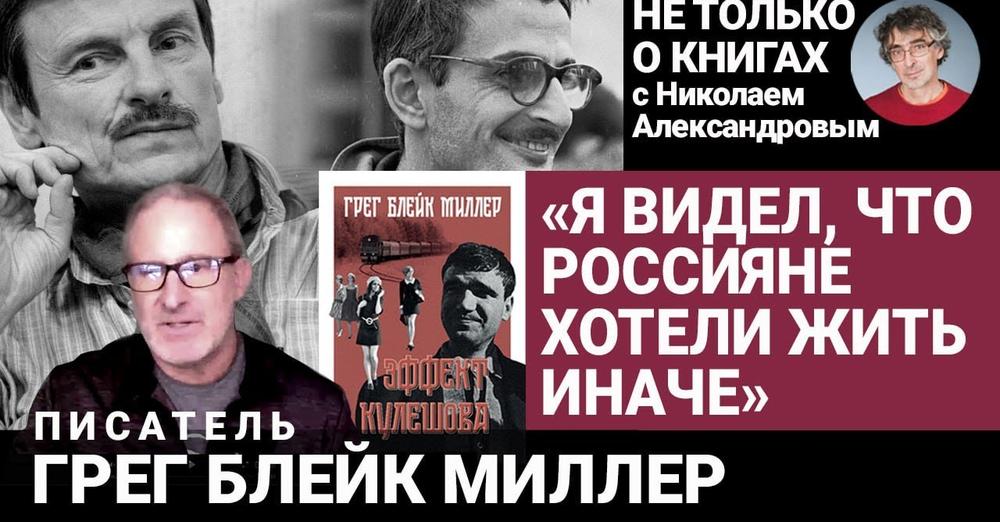
(Click here to watch the interview in Russian on YouTube.)
Last week, I was invited for an interview about my novel, “The Kuleshov Effect” («Эффект Кулешова»), with the outstanding Russian exile literary critic Nikolay Alexandrov. Nikolay’s show, “Not Just About Books,” is part of the YouTube channel “The Insider Live”—itself part of a remarkable dissident communication infrastructure cobbled together outside Russia by exiles in the wake of Putin’s war and repression.
I was nervous, naturally: a full hour in Russian taking questions from a very smart guy before an online audience that was probably wondering why on earth this American dude from Vegas has published a novel in Russian about the great cultural heroes of the Soviet Sixties, a time both heroic and tragic, when a seductive glimmer of hope and freedom appeared in the wake of Stalinist darkness … and then faded.
The interview was to be recorded Sunday morning and aired on Tuesday. I practiced on Saturday afternoon between stomach aches and then again very early on Sunday and then logged in for the Zoom call with Nikolay, who was in Europe, and the sound engineer in Tbilisi. Nikolay asked his first question and, as sometimes happens in sports, all of my tension went away and I was suddenly in a flow state, the proverbial “zone”. My Russian was still, of course, imperfect, but it felt (improbably, ten years after my last visit to Russia) like the best I’d ever spoken. Whatever corner of my brain I’d trained not just to speak a language but to BE in it had taken over.
And then, 50 minutes into the conversation, the sound engineer broke in:
“Guys, I’m very sorry, but the lights just went out in Georgia, and we lost the entire recording.”
Deep breath. Well, three deep breaths—mine, Nikolay’s, and the sound engineer’s.
I was given a choice to redo the interview later that day, sometime the next day, or, if I wanted, right now. I chose now.
I took a five-minute break, got a glass of water, rearranged my set-up because the sun was now blasting through my blinds and leaving strange stripes on my face, took yet another deep breath (you’ll see more of those in the video; one commenter wrote, “Greg even exhales in Russian”) and we began anew.
The result is posted here: My Russian was not nearly as clean, but I still was in the moment, being a Russian speaker rather than merely speaking in Russian. Sometimes my brain paused and buffered, but ever since my cage fight with Covid in 2020 it does that in English, too. And, toward the end of the show—the end of my second hour of being interviewed—I got tired … like, runner-at-marathon’s-end tired. At one point I rubbed my eye under my glasses, leading a conspiracy-minded commenter to ask what such a gesture symbolized. (I will tell him: Scratching my eye was a symbol for the fact that my eye itched.)
Nikolay was a remarkably good interviewer, insightful, challenging, empathetic, patient. His final question was a challenge to my linguistic subtlety and moral clarity: What would I want to ask of or say to contemporary Russian society?
Time was short, and I decided to speak not to those who have fallen in line with Putin’s war but to those left behind, trying to sustain life and hope while living under the suffocating weight of a government that has sacrificed the better angels of Russia’s nature on the pyre of national resentment, political opportunism, imperial delusion, and plain bloodlust.
I said that I know that the seed and spark of all that is best in Russian (and broader post-Soviet) culture remains, that kindness and humanity remain, that I know that these traits are aching to be seen and heard. I said that I have hope, a painful, halting, but real hope, that they will indeed be seen and heard. The kindness and genius I encountered among friends when I worked in Russia in the 1990s and among historical figures while I was researching the filmmakers of the 1960s for my dissertation and later for “The Kuleshov Effect” lives on, battered but but not fully defeated.
I am a romantic, of course; my brain senses the depths but my heart always insists there’s a way out. Within the course of my life, I said, we will see a better day. This, I said, is not simply my hope; it is my conviction.
 Reentry Shock